 How-to
How to Value Rare Pokémon Singles Before You Sell
Last Updated: October 30, 2026
Quick Summary
To value rare pokemon singles, identify the card exactly first by set name, card number, edition marker, and language, then compare it against recent sold listings rather than asking prices. Build a range from at least three clean comps sold within the last 90 days, then adjust for condition flaws.
- A Base Set Charizard is card 4/102; the same artwork in Base Set 2 carries a different number and far lower value.
- Rarity symbols sort cards but tell you almost nothing about price on their own.
- Never mix a graded sale into a raw average when building comps.
- Anything older than six months is context, not a price.
- We buy Pokémon singles valued over $10, along with graded Pokémon and sports cards.
Table of Contents
- Start With the Card's Identity, Not the Price
- How to Check Pokémon Card Value With Real Sold Prices
- Reading Pokémon Card Sold Prices Without Getting Fooled by Stale Data
- A Pokémon Card Condition Guide for Raw Singles
- How Graded Pokémon Card Values Differ From Raw Prices
- Authenticity, Alterations, and Counterfeit Risk on High-Value Singles
- Worked Example: Pricing One Rare Pokémon Single End to End
- Submitting Your Rare Pokémon Singles for a Quote
- Frequently Asked Questions
Start With the Card's Identity, Not the Price
The fastest way to value rare pokemon singles is to stop looking at prices first. Identify the card exactly, then price it. Skipping that step is how collectors confuse a $15 card with a $400 one.
Below, we'll show you an identity check that should come before any price on rare Pokémon singles.
Start with four facts:
- Set name (Base Set, Jungle, Evolving Skies)
- Card number (printed bottom-left or bottom-right, e.g. 4/102)
- Edition marker (1st Edition stamp, Shadowless, Unlimited)
Set, card number, and edition markers
The card number is the tiebreaker. A Base Set Charizard is 4/102. The same artwork reprinted in Base Set 2 carries a different number and a far lower value.
Edition markers matter just as much. A "1st Edition" stamp sits left of the artwork on vintage cards. Shadowless cards lack the drop shadow around the art box. Unlimited printings are the most common and the least valuable of the three.
Rarity symbols and what they actually signal
A rarity symbol is the small mark near the card number that tells you how often the card appeared in packs. A circle means common, a diamond means uncommon, and a star means rare.
Here's what most guides miss: rarity symbols tell you almost nothing about price on their own. A modern "secret rare" can outvalue an old star rare.
How to Check Pokémon Card Value With Real Sold Prices
To check Pokémon card value, compare your card against recent sold listings, not asking prices. An asking price is a wish. A sold price is a fact.
That single distinction separates a real price estimate from a guess. Sellers list high and hope. Buyers pay what the market supports.
How to pick comparable sales that match your card
Comparable sales are recent sold listings of the same card in similar condition. Bad comps are the number one reason people overprice a card.
Use this checklist before you trust any comp:
- Same set and card number
- Same edition (1st Edition vs. Unlimited)
- Same language
If you can't find three clean comps, widen the window to six months. Never mix a graded sale into a raw average.
Reading Pokémon Card Sold Prices Without Getting Fooled by Stale Data
Sold data goes stale fast. A sale from two years ago describes a different market, especially on modern chase cards that spike after a set release or a reprint announcement.
Watch for three traps:
- Stale sales. Anything older than six months is context, not a price.
- Outlier spikes. One auction can run hot. Ignore the top and bottom sale, then average the middle.
- Auction vs. Buy It Now. Auctions show true demand. Fixed listings show patience.
Pull three to five recent sales and build a range, not a single number. A range is honest. A single number is a sales pitch.
A Pokémon Card Condition Guide for Raw Singles
This Pokémon card condition guide covers the four things buyers inspect on an ungraded card: centering, corners, edges, and surface. Condition drives the biggest swing in value after rarity, and on raw singles it is the only variable you control before you price.
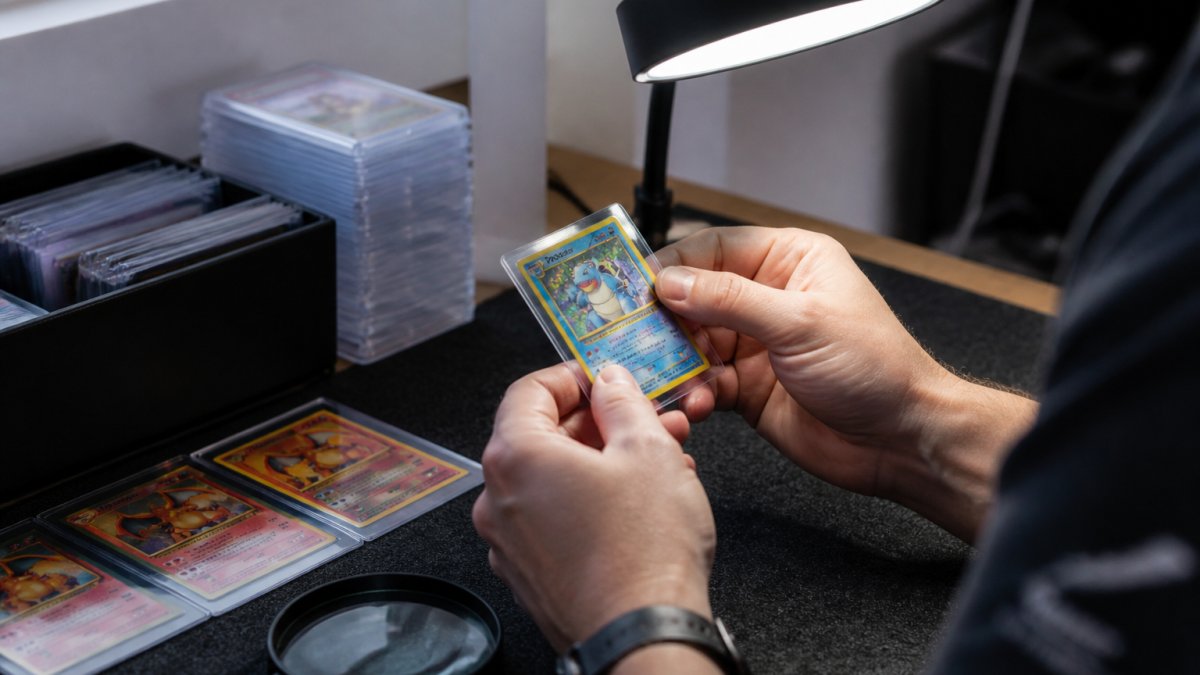
Grade yourself honestly against these markers:
- Mint: sharp corners, clean surface, near-perfect centering
- Near mint: one tiny flaw, light edge wear allowed
- Excellent: minor whitening, slight surface scuffs
Centering, whitening, and surface wear in practice
Centering is the border balance. Hold the card face-up and compare the left and right borders.
Whitening is the white showing through on the blue or black edge where ink has worn.
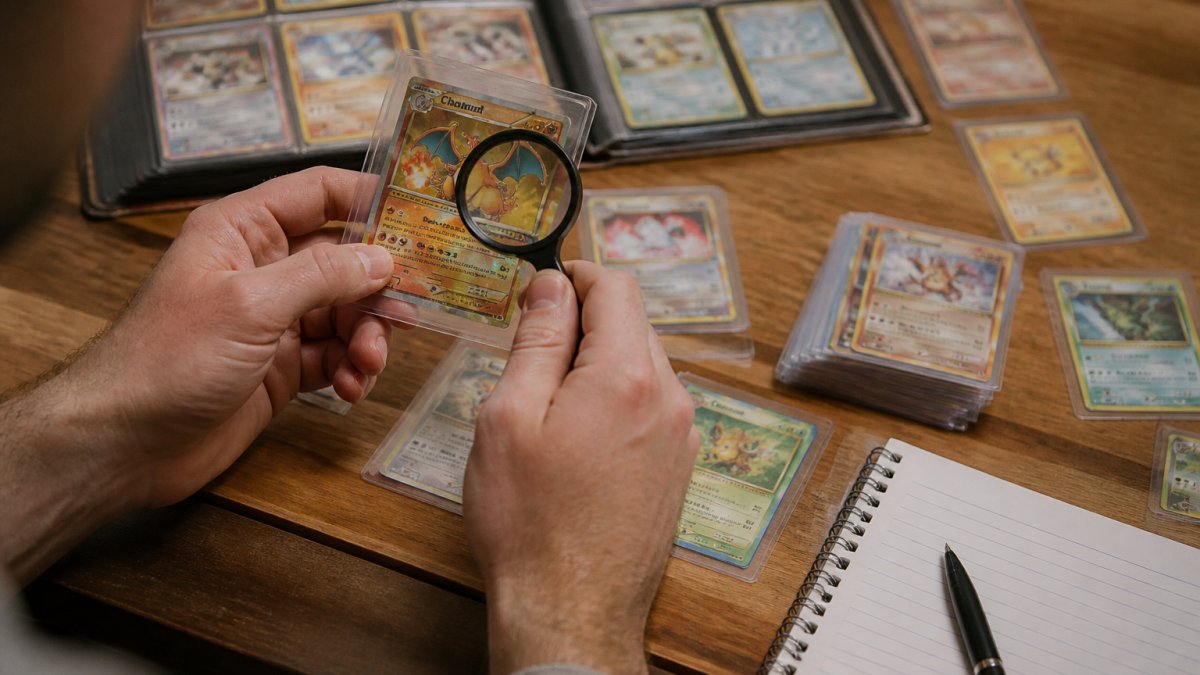
Surface wear means scratches, print lines, or holo scratching. On holographic cards, tilt the card side to side.
A common mistake is grading in soft light. Use a bright lamp and a dark background.
A visual checklist you can run in two minutes
Work through the card in this order so you do not miss a flaw that a buyer will spot instantly:
- Front centering. Measure the left and right borders with a ruler or a centering tool. Note the ratio (for example, 55/45).
- Back centering. Flip the card. Back centering is often worse than front and is a common reason a card grades lower than expected.
- Corners under light. Look for fuzzing, tiny bends, or color loss at each of the four corners. A single soft corner can drop a near-mint card to excellent.
- Edges under light. Run your eye along all four edges for whitening, nicks, or chipping. Pay extra attention to the top edge, which takes the most handling wear.
- Surface at an angle. Tilt the card toward a lamp and look for scratches, print lines, and holo scratching. On vintage holos, check the foil area specifically.
- Creases and dents. Hold the card at eye level and sight down the surface. A crease or dent shows as a shadow line even when it is hard to see face-on.
Turning flaws into a price adjustment
Condition only matters if you convert it into a number. Use the comp range you built from sold listings and adjust it with these rules of thumb. They are starting points, not gospel, so always check what the market is actually paying for cards in that condition.
- Centering worse than 65/35: expect a discount versus a well-centered comp. The wider the split, the larger the discount.
- Light edge whitening: a small discount off a true near-mint comp. This is the most common raw flaw and the easiest to over-penalize.
- One soft corner or a small surface scuff: move down one grade tier and price against comps in that tier.
A raw card is rarely one clean grade. Most fall between tiers, which is why a range beats a single number. Note the specific flaws, adjust the comp range, and you have a defensible raw estimate instead of a guess.
How Graded Pokémon Card Values Differ From Raw Prices
Graded Pokémon card values run higher than raw prices, but only when the grade is high and the card is in demand. A slab is a plastic case with a grade and serial number from a grading company.
The gap works like this:
| Card State | Buyer Confidence | Typical Price Position |
|---|---|---|
| Raw, near mint | Medium | Baseline |
| Graded mid-grade | High | Above raw |
| Graded high-grade | Very high | Top of range |
| Raw, played | Low | Well below baseline |
A high grade removes doubt about condition, so buyers pay for certainty. A low grade can actually hurt a card that looked clean raw. That's the trade-off nobody warns you about.
Authenticity, Alterations, and Counterfeit Risk on High-Value Singles
Counterfeits and trimmed cards are the quiet killer of high-value singles. A trimmed card has its edges shaved to improve centering. A counterfeit copies the artwork and back.
Check these before you price anything expensive:
- Light test: hold the card to a lamp. Real cards block light evenly.
- Texture check: run a fingernail lightly across the surface. Fakes feel flat.
- Edge inspection: look for uneven borders or fresh-cut edges.
If a deal looks too good, it usually is. Grading companies authenticate as part of the process, and that protection is part of what you pay for.
Worked Example: Pricing One Rare Pokémon Single End to End
Here's the full workflow on one clearly hypothetical raw holo rare, so you can see how the pieces connect. The card and the numbers are illustrative, not a quote on any real listing.
The card: a raw English holo rare from a modern set, card number confirmed, unlimited printing, no first-edition stamp. You grade it yourself as near mint with light edge whitening on the top edge and 60/40 front centering.
- Identify it. Confirm set, card number, edition, and language. You verify the card number against the set list and confirm it is the unlimited printing, not a reverse holo or a special illustration rare.
- Grade it yourself. Near mint with light edge whitening and 60/40 centering. You note the flaw specifically so you can adjust for it later.
- Pull comps. Find three to five raw near-mint sales from the last 90 days. Suppose the middle sales land at $180, $195, and $210. You ignore one outlier at $320 (a bidding war) and one at $120 (a card with a crease).
- Build a range. The middle sales give you a raw near-mint band of roughly $180 to $210.
- Adjust for flaws. The light top-edge whitening and 60/40 centering are minor but real. You knock the band down modestly, say to $165 to $195, because a buyer will compare your card to cleaner examples.
- Check fees. If you sell on a marketplace that takes a percentage, subtract that fee plus shipping. If you plan to grade it, subtract the grading fee and the risk that the grade comes back lower than expected. A slab that grades below near mint can be worth less than the raw card plus the grading cost.
- Set your number. That final figure is your net, and your floor for any offer. In this example, your defensible range is about $165 to $195 raw, and your net after fees is lower still.
Where the estimate can go wrong
- Stale comps. If your three sales are older than 90 days, the band may not reflect the current market, especially on modern chase cards.
- Mixed comps. If one of your sales was a graded copy or a different printing, the band is contaminated. Re-pull clean comps.
- Hidden flaws. A crease you missed turns a near-mint estimate into an excellent or good estimate. Inspect under bright light before you set a number.
A repeatable workflow beats a gut feeling every time.
Submitting Your Rare Pokémon Singles for a Quote
Ready to sell? Visit our website for current pricing and to request a quote.
We buy Pokémon singles valued over $10, along with graded Pokémon and sports cards. Our focus is on graded inventory and higher-end singles.
Best for: collectors with graded or higher-end singles.
Skip if: you're selling bulk commons with no individual value.
Frequently Asked Questions
Should I use asking prices or sold prices to value a rare Pokémon card?
Use sold prices. Asking prices are what sellers hope to get and often sit above what buyers actually pay. Filter your research to completed sales from the last 60 to 90 days, then discard outliers where one sale was far above or below the cluster. If a card has no recent sold listings, widen your search to the same card in a different grade or a close variant, and treat asking prices only as a loose ceiling rather than a value.
Are graded Pokémon cards always worth more than ungraded ones?
No. Grading adds value when the card scores high and the card is desirable enough that buyers pay for the certification. On a low-value single, the grading fee and shipping can exceed any premium the slab adds. On a genuinely rare card, a high grade from a recognized grader usually sells for more than the same card raw because buyers trust the condition and authenticity. Compare graded Pokémon card values against raw sold prices for the same card before deciding whether to grade.
How do I identify a rare Pokémon card if I don't recognize the set?
Read three things off the card: the set symbol near the bottom right, the card number in the corner (like 4/102), and any edition stamp under the artwork. The set symbol tells you which release it came from, the number tells you its position in that set, and a first edition stamp marks early print runs that collectors pay more for. Cross-check those details against a card database or scanning app before you assume a card is rare.
How much does condition actually change a raw card's value?
It can swing the price sharply. A near mint card with sharp corners, clean edges, and no surface scratches sits at the top of the raw market. Visible whitening on the back edges, centering that runs heavily to one side, or surface scratches drop it into lightly played or worse territory, and buyers discount accordingly. Photograph both sides in good light and compare your card against sold listings in matching condition rather than against the best example you can find.
Pricing rare Pokémon singles takes work, and one bad comp can cost you real money. We built our buyback process to remove that guesswork: send photos, get a straight quote, and know your number before anything ships. Get started with bryan sports cards and turn your rare Pokémon singles into a fair, no-surprise offer.