 How-to
The Best Way to Ship Expensive Cards Safely
Last Updated: November 1, 2026
Quick Summary
The best way to ship expensive cards is to match your shipping method to card value: plain envelope under $20, bubble mailer with tracking from $20 to $250, and a box with full tracking and insurance at $250 and up. Always use a penny sleeve, top loader, and cardboard sandwich.
- Graded slabs above $500 should ship in a box only, never a mailer.
- Tape the top loader opening with a folded pull tab so buyers can remove it safely.
- Photograph the packed box with the label visible before sealing any high-value shipment.
- USPS Ground Advantage replaced First-Class Package Service and Parcel Select Ground in 2023.
- Signature confirmation is worth adding above $250 because it records who received the package.
Table of Contents
- Match Your Shipping Method to Card Value
- How to Package Trading Cards for Shipping
- How to Ship Graded Cards Without Cracking the Slab
- Shipping Trading Cards in a Bubble Mailer or Box
- Trading Card Shipping Insurance and Tracking
- Carrier and Service Comparison for Card Sellers
- Document Every High-Value Shipment Before It Leaves
- Selling Your Cards to a Buyer Who Handles Shipping
- Frequently Asked Questions
Match Your Shipping Method to Card Value
The best way to ship expensive cards starts with one rule: match your shipping method to what the card is worth. At bryan sports cards, we buy graded Pokemon and sports cards.
Here is the short answer. Cheap raw singles go in a plain white envelope with a stamp. Mid-range cards go in a bubble mailer with tracking.
The USPS shipping guidelines confirm that tracking and insurance are separate services, and both cost extra. That matters when you price your shipping.
The Value-Based Decision Tree
Use this framework before you pack anything:
- Under $20: Plain white envelope, penny sleeve, top loader, one stamp. No tracking.
- $20 to $75: Bubble mailer with tracking. Top loader plus rigid backing.
- $75 to $250: Bubble mailer or small box, tracking, signature optional.
| Card Value | Packaging | Tracking | Insurance |
|---|---|---|---|
| Under $20 | Envelope + top loader | No | No |
| $20-$75 | Bubble mailer | Yes | Optional |
| $75-$250 | Mailer or small box | Yes | Recommended |
| $250+ | Box only | Yes | Yes |
That table is the whole system in one glance.
How to Package Trading Cards for Shipping
Packaging trading cards for shipping comes down to three jobs: protect the surface, stop movement, and add rigid backing. Skip any one and you're gambling with corner damage or bending.
Start with a penny sleeve to keep dust and moisture off the surface and stop the card from sliding.
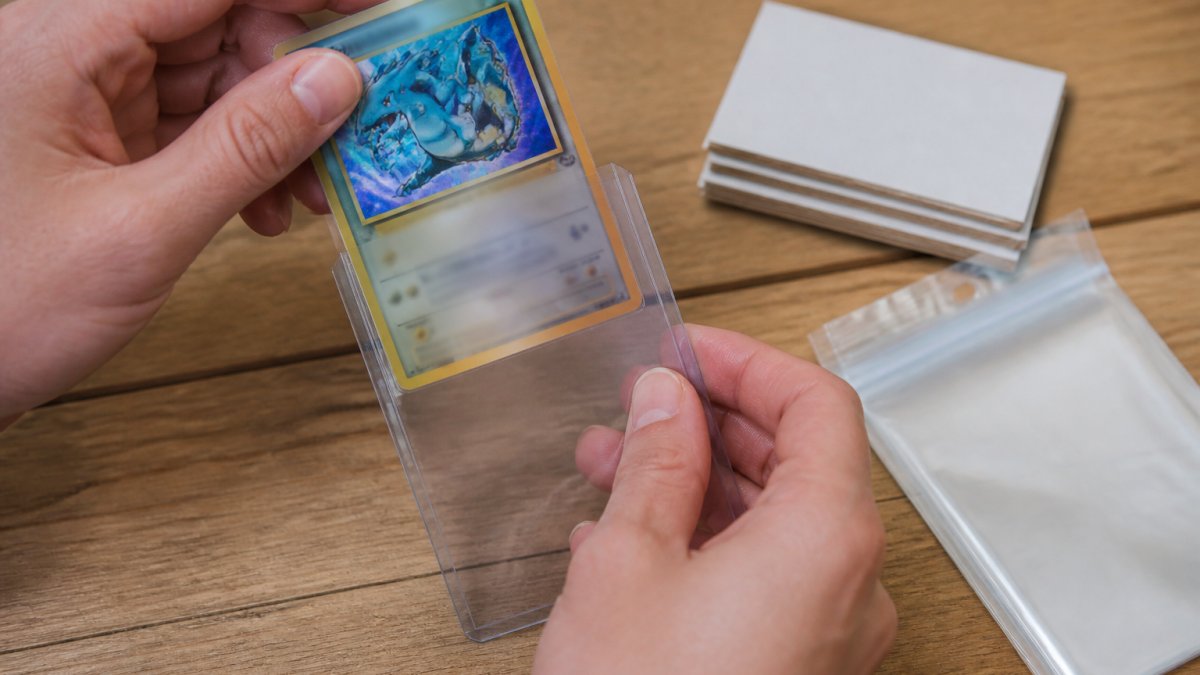
Sleeve, Holder, and Rigid Backing
The order matters: sleeve first, then holder, then backing.
- Penny sleeve: protects the surface from scratches.
- Top loader or semi-rigid holder: stops bending.
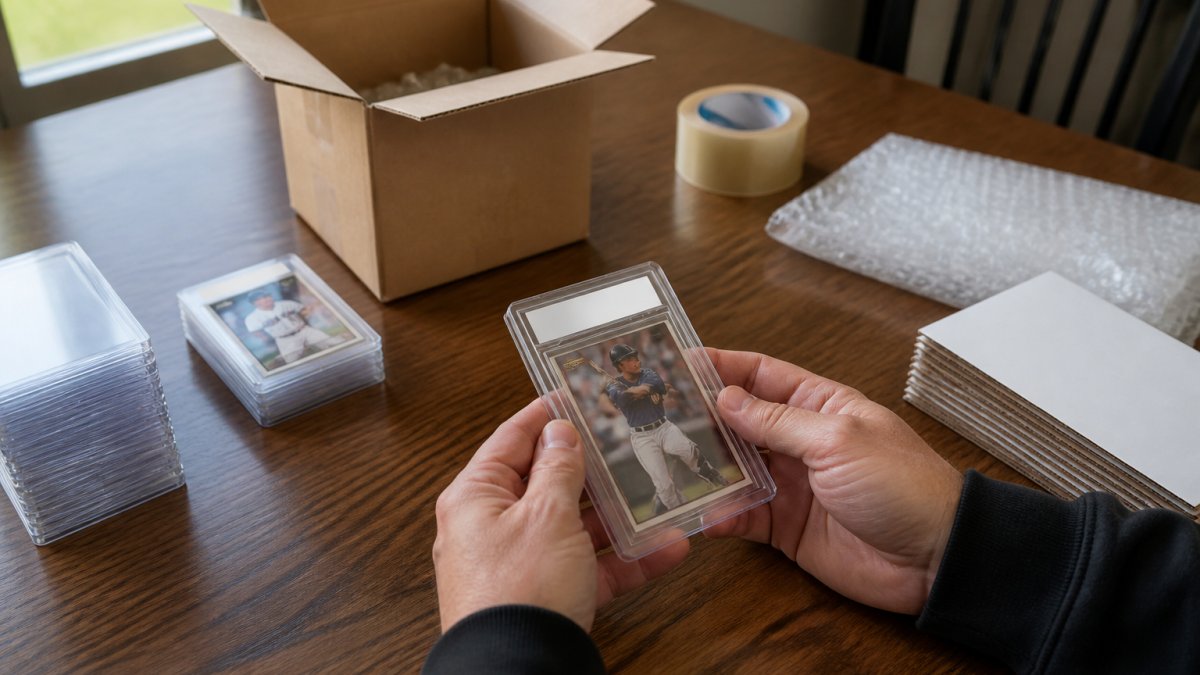
- Tape the top of the holder: a small piece of tape over the opening keeps the card from sliding out. Fold one end of the tape so the buyer can remove it.
- Cardboard sandwich: place the holder between two pieces of rigid cardboard, slightly larger than the card.
- Team bag: seal the whole stack in a team bag so nothing shifts in transit.
A common mistake is taping directly over the top loader opening with no fold. The buyer then fights the tape and risks bending the card. Always leave a pull tab.
Skipping the cardboard sandwich is the most common cause of bending damage; a top loader alone flexes in a sorting machine.
How to Ship Graded Cards Without Cracking the Slab
Graded cards need different handling because a cracked slab destroys the grade and the value.
Follow this workflow:
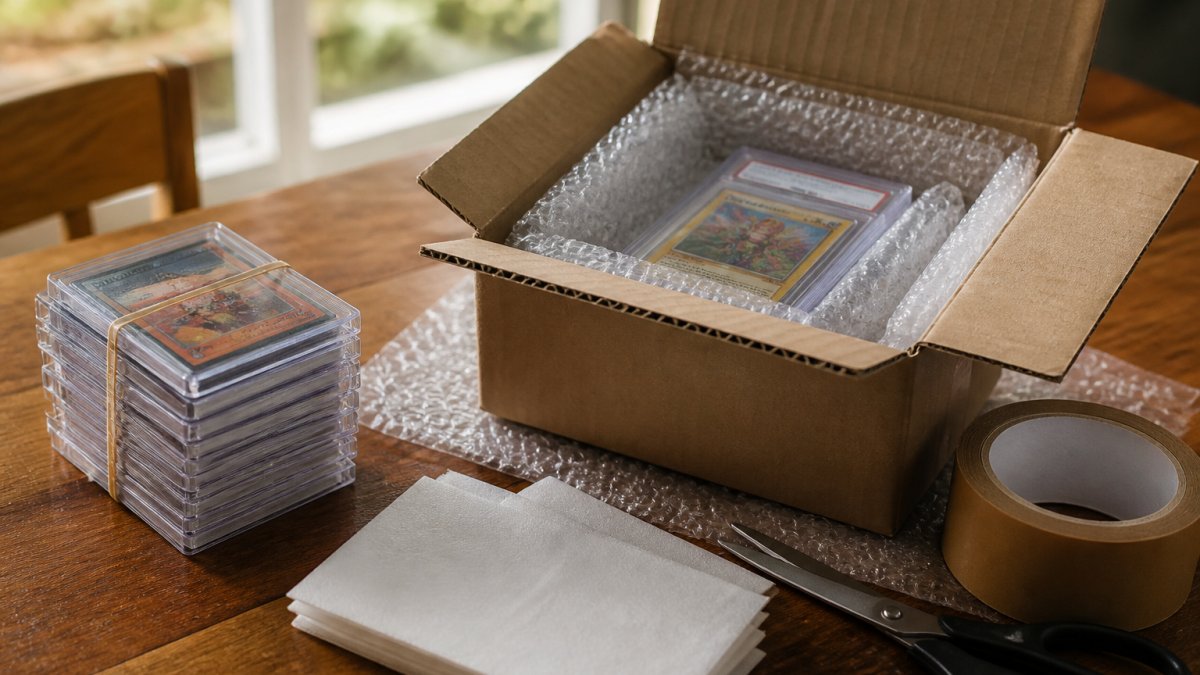
- Wrap the slab in bubble wrap, at least two layers.
- Fill the rest of the box with packing peanuts or crumpled paper.
- Shake the box before sealing. If anything moves, add more packing material.
The USPS packaging restrictions prohibit reusing certain containers and require proper cushioning, so check the rules before you ship.
For slabs above $500, photograph the slab from every angle before it goes in the box. That photo set is your evidence if a claim comes up later.
Shipping Trading Cards in a Bubble Mailer or Box
Shipping trading cards in a bubble mailer or box is the choice most sellers face: mailers work for mid-range cards, boxes protect high-value cards and slabs.
A bubble mailer is cost effective and lightweight, handling cards from $20 to $250 well provided you use the cardboard sandwich inside.
| Feature | Bubble Mailer | Box |
|---|---|---|
| Best for | $20-$250 cards | $250+ and slabs |
| Rigid walls | No | Yes |
| Padding room | Limited | Full |
| Cost | Lower | Higher |
| Crush protection | Moderate | High |
One insider tip: a bubble mailer's bubbles flatten under heavy stacking. If your card is near the top of the range, upgrade to a box.
Trading Card Shipping Insurance and Tracking
Trading card shipping insurance and tracking are two separate add-ons, and both matter once a card passes $75. Tracking proves the package moved and where it stopped; insurance covers you if it's lost or damaged. Most denials come from missing evidence, not from the carrier refusing to pay.
Coverage Limits and Exclusions
Common exclusions to watch for:
- Improper packaging. If the carrier determines the card was poorly packed, the claim can be denied. This is why the cardboard sandwich and rigid backing matter.
- Prohibited items. Cards are generally allowed, but check the carrier's rules for restrictions on collectibles or high-value goods.
- Concealed damage. If the outside of the box looks fine but the card inside is damaged, you need photos of both the packaging and the card.
Proof-of-Value Requirements
Carriers want proof the card was worth what you declared. A sale record, invoice, or completed marketplace transaction is the strongest proof; a screenshot of a listing is weaker. Photos before packing establish condition but don't prove value, so keep both.
How to File a Claim
The process is similar across carriers, but the details differ:
- Report the problem fast. Start the claim as soon as you know the package is lost or damaged. Don't wait for the buyer to file.
- Gather your evidence file. Photos of the card, photos of the packed box, the tracking number, the declared value receipt, and the sale record.
- Submit the claim through the carrier's online portal. USPS, UPS, and FedEx all have online claim forms. Keep a copy of everything you submit.
- Respond to requests for more information. Carriers often ask for additional photos or documentation. Answer quickly; delays can close the claim.
- Track the outcome. If the claim is denied, read the reason carefully. Many denials can be appealed with better documentation.
- Declared value: state the real value, not a low number to save postage. Under-declaring saves a few dollars but caps your payout.
- Tracking: always add it above $20. Without tracking, you can't prove the package was ever in the carrier's hands.
- Signature confirmation: worth it above $250. It creates a record of who received the package and when.
The USPS insurance and claims information explains how claims work and what evidence they require. Read it before you need it, and check the equivalent pages for UPS and FedEx if you use those carriers.
Carrier and Service Comparison for Card Sellers
Carriers differ in cost, speed, tracking quality, and how they handle claims. Pick based on the card's value, not habit. The table below compares the services most card sellers actually use, with the trade-offs that matter when a card is worth more than the postage.
| Service | Best For | Tracking | Insurance | Typical Cost (USD) | Key Trade-off |
|---|---|---|---|---|---|
| First-Class Mail envelope | Raw singles under $20 | No | No | $0.73-$1.00 (stamp) | Cheapest, but no proof of delivery and no coverage |
| USPS Ground Advantage | Mid-range cards $20-$250 | Yes | Up to $100 included | $4-$9 depending on weight and zone | Good balance of cost and tracking; insurance above $100 costs extra |
| USPS Priority Mail | High-value cards $250+ | Yes | Up to $100 included | $8-$15+ depending on weight and zone | Faster, stronger tracking scans, but insurance above $100 is an add-on |
| USPS Priority Mail Express | Urgent high-value sales | Yes | Up to $100 included | $25-$45+ | Fastest, most expensive; rarely worth it for cards unless the buyer pays |
| UPS Ground | High-value cards and slabs | Yes | Declared value coverage available | $10-$20+ | Strong claim process, but higher base cost and no free coverage tier |
| FedEx Ground | High-value cards and slabs | Yes | Declared value coverage available | $10-$20+ | Similar to UPS; check the declared-value limit before you ship |
A few practical notes that the table can't capture:
- USPS Ground Advantage replaced First-Class Package Service and Parcel Select Ground in 2023. If you're following an old guide that says "First-Class Package," that service no longer exists under that name. Ground Advantage is the current mid-tier option and includes tracking plus $100 of insurance.
- The $100 included insurance is a floor, not a ceiling. For a $400 card, buy additional coverage or use a service with a higher declared-value limit.
- Tracking quality varies. USPS tracking is adequate for most card shipments, but UPS and FedEx tend to produce more granular scan events, which matters if you need to prove where a package was last seen.
For expensive cards, the decision usually comes down to USPS Priority Mail versus UPS or FedEx Ground. Priority Mail is cheaper and faster for most domestic shipments, but UPS and FedEx often have a smoother claim experience. If you ship high-value cards regularly, test both and track which one pays claims faster for you.
Document Every High-Value Shipment Before It Leaves
Documentation is your insurance policy in practice. Before any high-value card leaves your hands, build an evidence file, the step competitors skip, and the one that saves you in a dispute.
Your evidence file should include:
- Photos of the card front and back, in focus.
- Photos of the slab or holder before packing.
- A photo of the packed box with the label visible.
- The tracking number and declared value receipt.
Store these in one folder per shipment. If a buyer claims damage, you have proof of condition at the moment of shipping, the difference between a paid claim and a loss.
Selling Your Cards to a Buyer Who Handles Shipping
Sometimes the best way to ship expensive cards is not to ship them at all. If you're selling a collection, you can hand the packing risk to a buyer who does it every day.
At bryan sports cards, we buy graded Pokemon and sports cards and Pokemon singles valued over $10. We prioritize graded inventory and higher-end singles.
Frequently Asked Questions
What is the safest way to ship an expensive trading card?
The safest approach combines rigid protection with a tracked, insured service. Put the card in a penny sleeve, then a semi-rigid holder or top loader, tape the holder shut, and sandwich it between two pieces of cardboard. Slide that into a bubble mailer or small box, and ship it with USPS tracking plus insurance for the full declared value. Photograph the packed item before sealing so you have evidence if a claim is needed.
Should I ship valuable cards in a bubble mailer or a box?
Use a bubble mailer for cards worth roughly $20 to $200 that are already in a rigid holder with cardboard backing. Switch to a small box for anything above that range, for graded slabs, or when you are shipping multiple cards together. A box gives the card room to stay flat and absorbs impact better, and the extra postage is small compared to the loss on a damaged high-value card.
Can trading cards be sent via media mail?
No. USPS Media Mail is limited to books, recordings, and certain educational materials. Trading cards, including sports cards and TCG cards, are generally not eligible for Media Mail. Use a tracked service for every shipment.
Should I insure an expensive trading card when shipping it?
Insure any card whose value you could not comfortably absorb if it disappeared. Keep your original purchase receipts or recent sold listings, and document the packed box before it ships.
Shipping expensive cards is a skill, and the stakes are real. One crushed corner or cracked slab can wipe out a sale. bryan sports cards buys graded Pokemon and sports cards and high-value singles, with a quote-first process, a focus on premium inventory, and a streamlined buyback built for collectors who want fair value without the shipping headache. Get started with bryan sports cards and turn your collection into cash.