 How-to
7 Steps to Determine Trading Card Value for Insurance
Last Updated: October 25, 2026
Quick Summary
Trading card value for insurance is the replacement value, what it would cost today to buy the same card back, not the price from a single auction. Confirm your policy's sublimit, deductible, and exclusions first, then build a defensible figure from dated comparable sales, condition notes, and photos.
- A single auction result is one data point; replacement cost asks what you would pay today for a comparable card.
- Many homeowners policies apply a collectibles sublimit far below the overall personal property limit.
- Pull comps from sold listings, not asking prices, and use the middle of the range, not the highest outlier.
- A graded card carries a grade-specific value that is far easier to document and defend than a raw card.
- Update your inventory at least once a year, and sooner if the market shifts.
Table of Contents
- Why Insurance Value Differs From What a Card Sells For
- Step 1: Identify Every Card by Player, Set, Year, and Card Number
- Step 2: Pull Comparable Sales From Sold Listings and Auctions
- Step 3: Score Condition and Decide Whether Grading Changes the Number
- Step 4: How to Value a Trading Card Collection Card by Card
- Step 5: How to Document Trading Cards for Insurance With Photos and Receipts
- Step 6: When a Trading Card Insurance Appraisal Is Worth Paying For
- Step 7: Use a Card Scanner App for Sports Cards to Keep Values Current
- Frequently Asked Questions
Why Insurance Value Differs From What a Card Sells For
Trading card value for insurance is not the price a card fetched on eBay last week.
At bryan sports cards, we see this confusion constantly. A card that sold high in a hot market may not be replaceable at that number six months later.
Here is the practical difference:
- Sale price: one transaction, one moment, one buyer.
- Fair market value: the typical price across many recent sales.
- Replacement value: what you would pay today to buy the same card back.
For a policy, replacement value usually wins, that is the number you need to prove. But the valuation basis is only half the story; the other half is whether your policy actually covers the card, and at what amount.
The Policy Mechanics That Decide Whether Your Card Is Covered
A defensible valuation is worthless if the loss falls outside your coverage. Before building comps, read the policy and answer these questions.
Is the collection covered at all? Homeowners and renters policies typically cover personal property, but collectibles are often treated differently.
What perils are covered? A standard policy may cover fire and theft but exclude or limit other causes of loss.
Replacement Cost Versus a Single Auction Result
Even when coverage is confirmed, the valuation basis matters. A single auction result is one data point; replacement cost asks what you would pay today for a comparable card, which can differ from the last sale for several reasons:
- Supply shifts. A new release or a large collection coming to market can move prices quickly in either direction.
- Timing. A sale from six months ago may not reflect today's market, especially for volatile categories.
- Grade and variation. A like-for-like replacement must match the grade, parallel, and serial number, and those may trade at different levels than the card that sold.
The goal is a replacement figure you can defend with dated comps, condition notes, and photos, and a policy that actually pays on it.
Step 1: Identify Every Card by Player, Set, Year, and Card Number
Start with identification, because nothing downstream works without it. Two cards can look nearly identical and carry wildly different values; the set, year, card number, and any parallel or variation decide which one you own.
Write down these fields for every card:
- Player or character name
- Set name and year
- Card number
A common mistake is lumping cards together as "a stack of 1990s basketball." That tells an insurer nothing. Card identification is the foundation of any credible valuation.
Step 2: Pull Comparable Sales From Sold Listings and Auctions
Comparable sales, or comps, are your best evidence of trading card value. Look at sold listings, not asking prices. Anyone can list a card for any number. What matters is what buyers paid.
Filter your comps by these factors:
- Same card, same variation
- Same grade, or close to it
- Sold within the last few months
Recent sales beat old ones. Auction price data from a well-trafficked marketplace carries more weight than a single private sale. Collect several comps and use the middle of the range, not the highest outlier.
Step 3: Score Condition and Decide Whether Grading Changes the Number
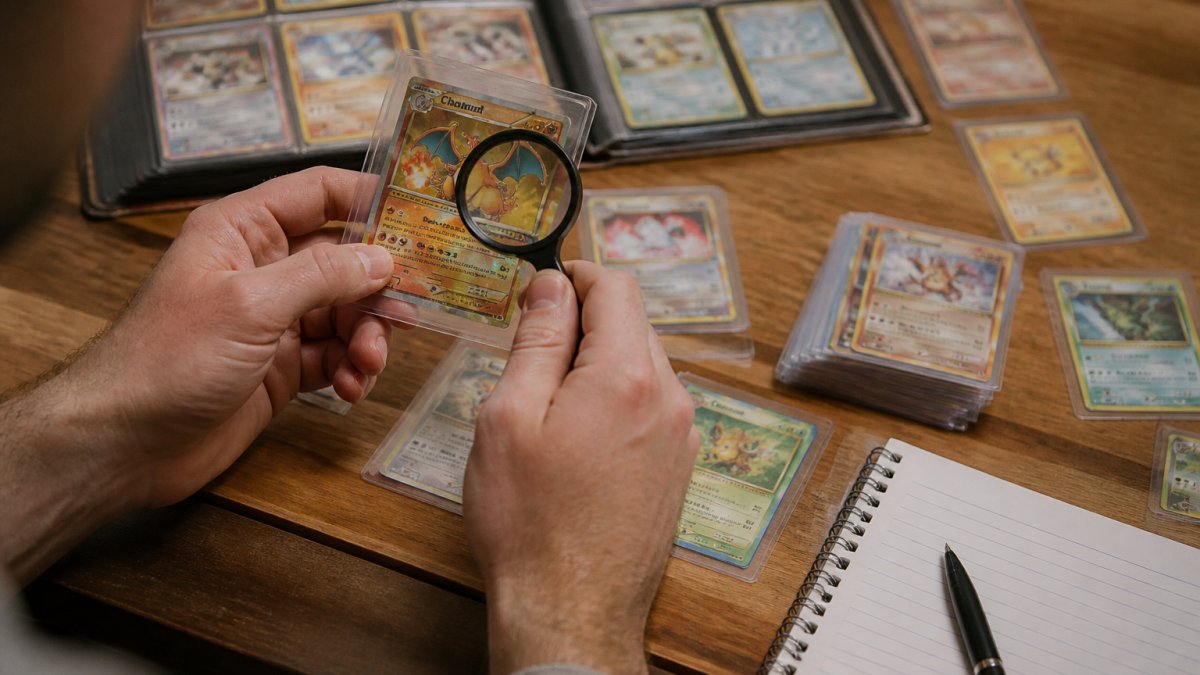
Condition drives value more than almost anything else.
Professional grading from a recognized grading service settles the question. A graded card carries a grade-specific value that is far easier to document and defend.
Here is how we think about it:
| Situation | Grading Worth It? | Why |
|---|---|---|
| High-value card, sharp condition | Yes | Locks in a defensible grade and value |
| Mid-value card, uncertain condition | Sometimes | Grade may not cover the cost |
| Low-value common card | No | Grading cost outweighs value |
| Card with visible flaws | Usually no | Grade will cap the value anyway |
Check the population report before you grade. A high grade on a card with thousands of examples is worth less than the same grade on a scarce one.
Step 4: How to Value a Trading Card Collection Card by Card
Valuing a collection means working card by card, then adding it up. Skip the shortcut of guessing a lump total, insurers want an itemized inventory, and you want the number to hold up at claim time.
Build a simple sheet with one row per card and these columns:
- Card identity
- Condition or grade
- Comps used
Raw Cards Versus Graded Cards on the Same Inventory Sheet
Treat raw and graded cards differently on the same sheet. A graded card gets its grade-specific value from recent sales of that exact grade. A raw card gets a range, because condition is open to interpretation.
Most guides get this wrong, valuing everything at one blended number. Separate the two categories and your documentation is far stronger.
Step 5: How to Document Trading Cards for Insurance With Photos and Receipts
Documentation is the step people skip and the one insurers care about most. You need proof of ownership, condition, and value, photos and receipts cover all three.
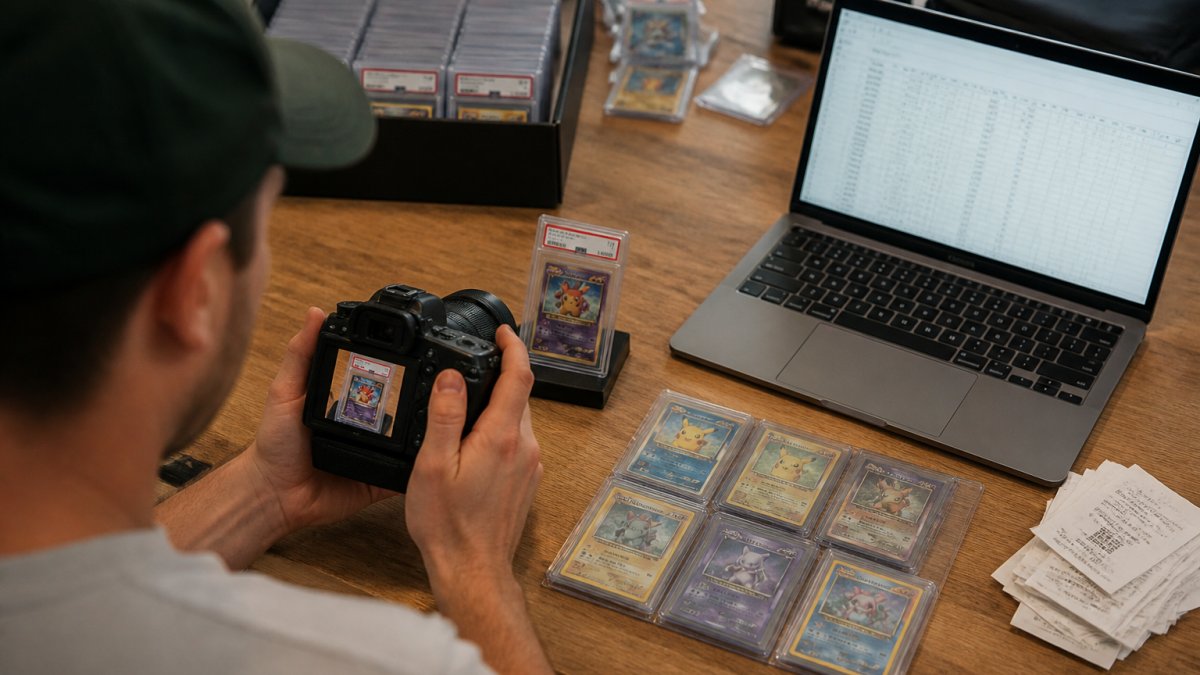
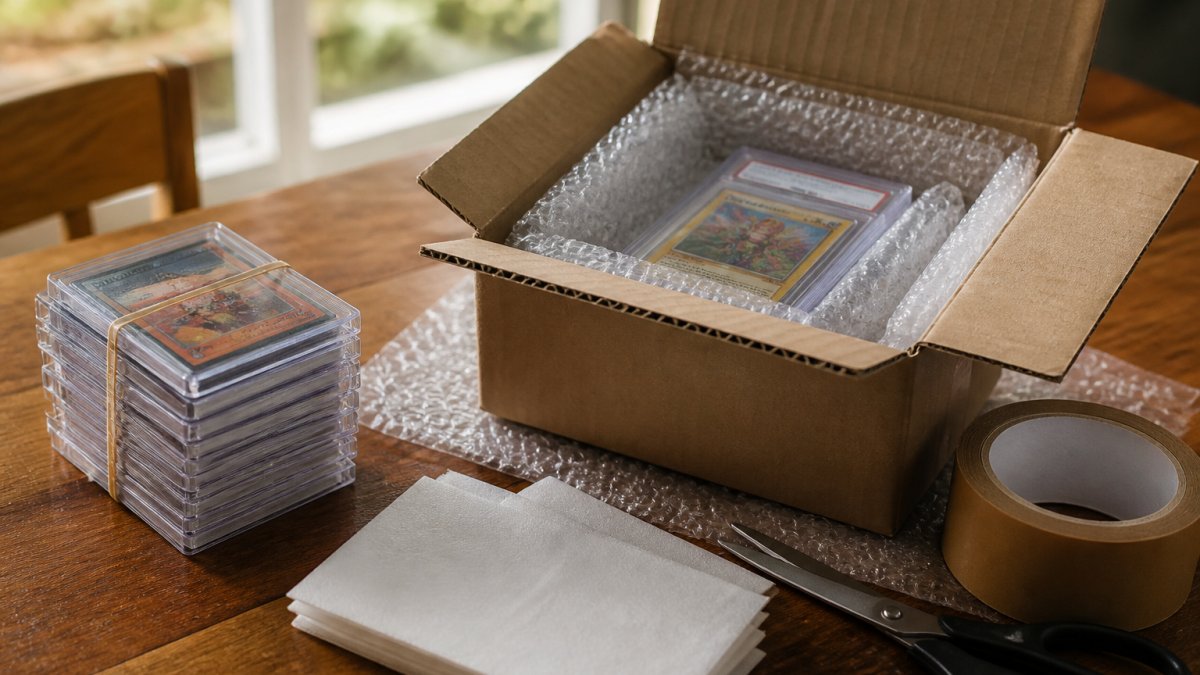
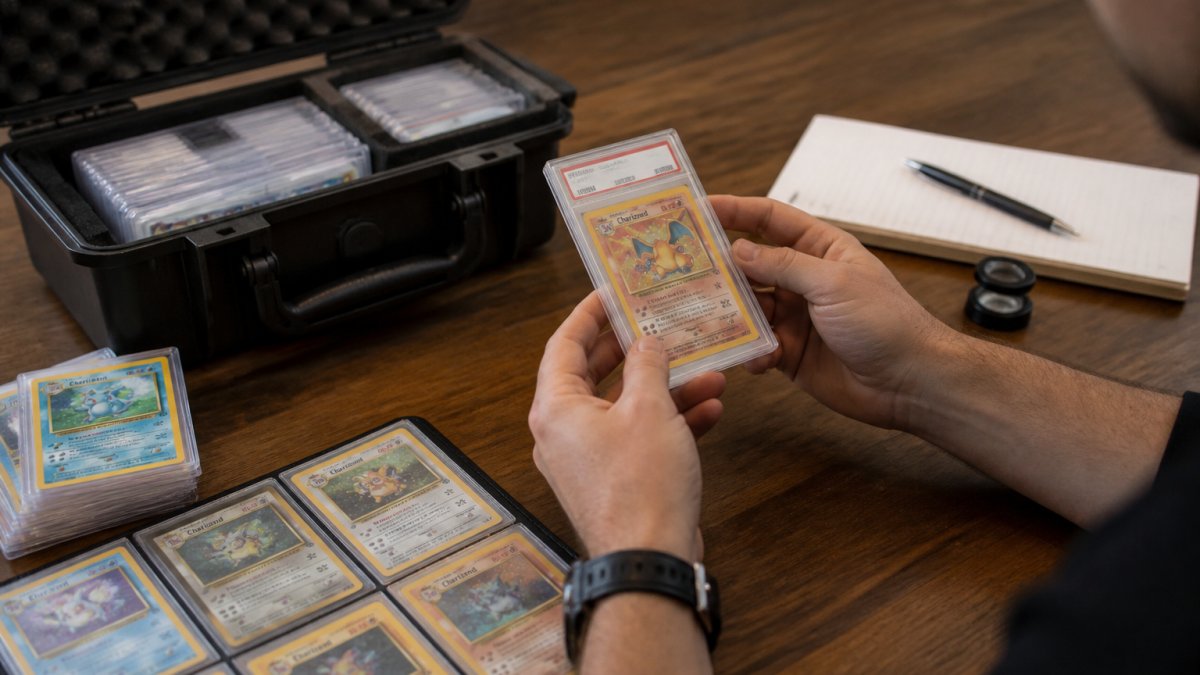
Photograph each card front and back in good light, capture the label on graded slabs, and keep purchase receipts, grading records, and sale confirmations.
A practical checklist for documenting trading cards for insurance:
- Front and back photo of every card
- Close-up of the grade label on slabs
- Receipt or proof of purchase
Watch out: a folder of phone photos with no inventory sheet is weak evidence.
Step 6: When a Trading Card Insurance Appraisal Is Worth Paying For
A professional appraisal makes sense when the stakes justify the cost. For a collection with real value, an independent appraisal gives the insurer a number they can trust and protects you at claim time.
Consider a trading card insurance appraisal when:
- Your collection value is high enough that a loss would hurt
- You hold rare or serial-numbered cards
- You need to settle a claim dispute
For smaller collections, your own documented comps may be enough. Ask your insurer what evidence they require before you pay for an appraisal you may not need.
What a Usable Appraisal Report Contains
An appraisal is only as good as its documentation. A report that says "collection valued at $X" with no supporting detail will get bounced back. Ask the appraiser to include:
- A stated valuation basis. The report should say plainly whether it is a replacement cost valuation, a fair market value, or a liquidation value. For insurance, replacement cost is usually the relevant basis, and the report should say so on its face.
- An effective date. Values move. An appraisal is a snapshot, and the insurer needs to know which day the number describes.
- Itemized entries. One line per card with player or character, set, year, card number, parallel or variation, serial number if any, grade and grading company if slabbed, and the value assigned to that card.
Choosing an Appraiser for a Card Collection
Card appraisal is not a licensed profession like real estate appraisal, so credentials vary. Look for someone with a track record in your specific category, sports cards, trading card games, or both, who will put their methodology in writing.
Be wary of an appraiser who also offers to buy the collection. An independent number is worth more to an insurer than one prepared by a party with a financial interest in the outcome.
How the Appraisal Ties to the Policy
An appraisal does not automatically set your coverage. It is evidence you present to the insurer, who may accept it, ask for revisions, or use it to set a scheduled limit.
For collections below the threshold where an appraisal pays for itself, your own itemized inventory with dated comps serves the same evidentiary purpose. The appraisal is a stronger version of the same argument, not a different one.
Step 7: Use a Card Scanner App for Sports Cards to Keep Values Current
Values move. A valuation you built last year may be stale today. A card scanner app for sports cards helps you track prices and keep your inventory current without rebuilding the whole sheet by hand.
Price fluctuation is real, and insurers know it. Update your inventory at least once a year, and sooner if the market shifts. Value tracking keeps your coverage aligned with replacement cost.
A few habits that keep values fresh:
- Re-check comps on your top cards quarterly
- Note the date of every valuation
- Flag cards that moved sharply
- Re-photograph any card that gets regraded
Frequently Asked Questions
Should I insure my trading cards at market value or replacement cost?
Replacement cost is the figure most policies use, because it reflects what you would pay to buy the same card again in similar condition. Recent sold listings tell you what buyers paid, which is a useful starting point, but a card that sold cheaply in a thin market may cost more to replace. Record both numbers on your inventory sheet and note which one your policy language actually references. Ask your insurer in writing which basis applies before you set a coverage limit.
Does a card's grade change its insurance value?
Yes, often by a wide margin. A graded card carries a numeric grade from a grading service, and buyers pay according to that grade, so the replacement cost of a high-grade copy can be several times the price of the same card raw. Record the grading service, the exact grade, and the certification number for every slabbed card. For raw cards, describe condition honestly using centering, corners, edges, and surface, since an insurer will treat an ungraded card as lower value until proven otherwise.
Is there a free app to check the value of baseball cards?
Several card scanner apps for sports cards offer a free tier that identifies a card from a photo and shows recent sale data. Free tiers usually limit how many scans you get per month and may show fewer comps, so treat the output as a starting point rather than a final number. Confirm any value against actual sold listings on an online marketplace before you enter it in your insurance inventory. Paid tiers typically add export and collection-tracking features that make annual updates faster.
How often should I update my trading card insurance inventory?
Once a year at minimum, and again after any significant purchase or sale. Card prices move with player performance, set releases, and grading population reports, so a value recorded two years ago may no longer reflect replacement cost. Rerun your comps, update each line on the inventory sheet, and save the new version with the date. If a single card crosses a threshold your policy treats as a scheduled item, tell your insurer rather than waiting for renewal.
Knowing what your cards are worth is one thing. Turning that knowledge into a fair payout is another. If you are ready to sell premium graded cards or high-value Pokemon singles, bryan sports cards offers a streamlined buyback process built for serious collectors. We specialize in graded inventory and higher-end singles, and we prioritize quality at every step. Get started with bryan sports cards and turn your collection into cash without the guesswork.